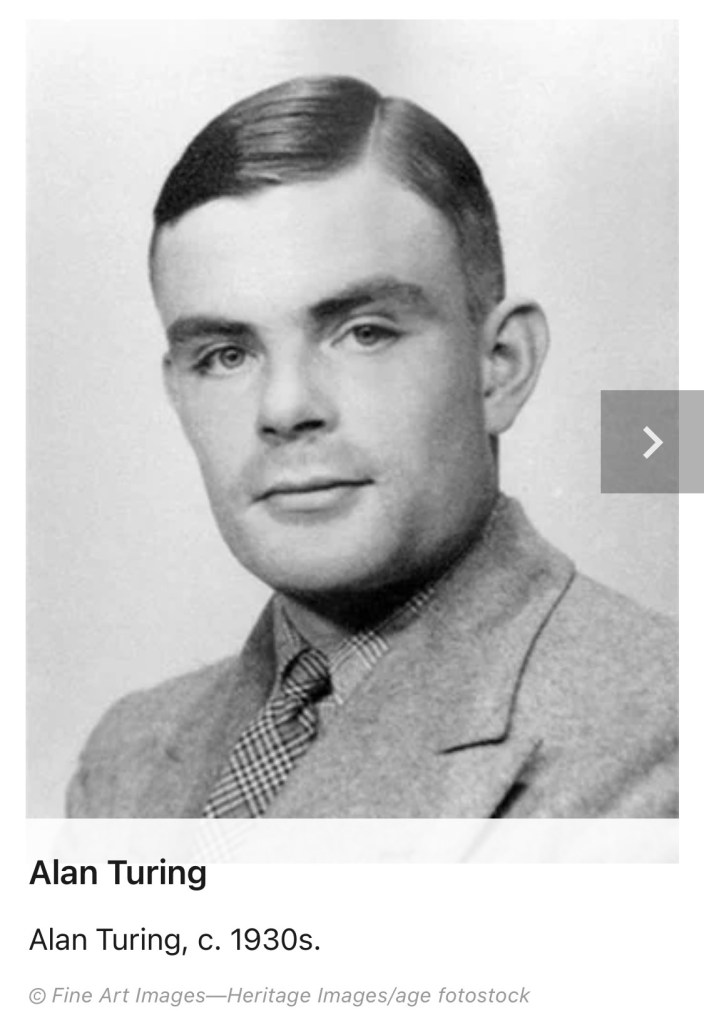
The amazing and tragic life of Alan Turing.
Alan Turing was a remarkable British mathematician, logician, and computer scientist. He was born on June 23, 1912, and is widely considered one of the pioneers of modern computer science and artificial intelligence.
During World War II, Turing played a crucial role in the British code-breaking efforts at Bletchley Park. He helped decrypt German Enigma machine-encrypted messages, providing valuable intelligence to the Allies. His contributions to the field of cryptography were immensely significant. At the end of the war, Turing was made an Officer of the Most Excellent Order of the British Empire (OBE) for his code-breaking work.
Turing’s most famous concept is the “Turing Test,” which he proposed in 1950 as a means to evaluate a machine’s ability to exhibit intelligent behavior indistinguishable from that of a human. The test involves a human evaluator interacting with a computer program and a human via a text-based interface. If the evaluator cannot consistently distinguish between the machine and the human, the machine is considered to have passed the test. Alan predicted that by approximately the year 2000, machines would be able to pass the test with a 30-minute conversation.
Besides the Turing Test, he made significant contributions to theoretical computer science. His work on the concept of a “universal machine” laid the foundation for modern computing and led to the development of stored-program computers.
Despite his groundbreaking contributions, Turing faced tragic circumstances. In 1952, he was prosecuted for “gross indecency” (i.e. homosexuality), which was illegal at the time in the UK. He underwent 12 months of hormone therapy (i.e. chemical castration) as an alternative to imprisonment. Turing tragically died on June 7, 1954, at the age of 41, due to cyanide poisoning. In 2013, he was posthumously granted a royal pardon for his conviction by Queen Elizabeth II.
Alan Turing’s legacy is immense, and his work continues to influence fields such as computer science, artificial intelligence, and cryptography. He is celebrated for his pioneering ideas and his profound impact on the development of computing technology.
 C. Austin Insight